


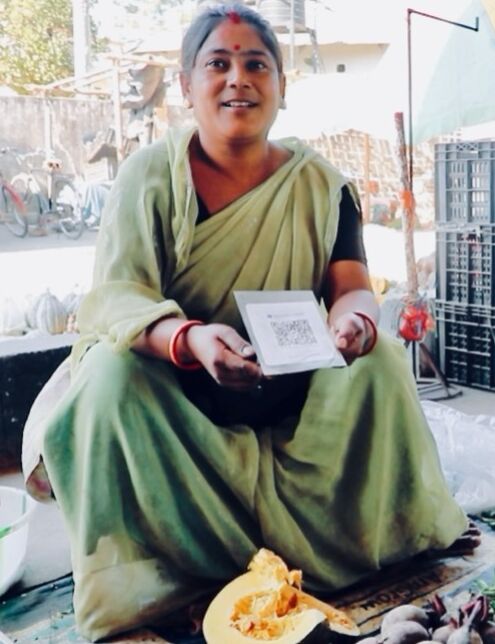
In Jagiroad, about 86 kilometres from Guwahati, deeper into Assam in India’s Northeast—often described as the country’s eastern frontier, Anupama Medhi, 42, arrives before the weekly market has fully found its voice. The day begins the way it always does: she and her husband go first to the mandi (a wholesale produce market), buy vegetables in bulk, and then sell them piece by piece to people who measure the week’s budget as carefully as they measure coriander. By the time the first customers drift in, her stall is already arranged with the precision of habit—okra stacked like small green promises, tomatoes turned to show their best side, coriander tied into neat bundles. Her stall is small, but her arithmetic is not. When you ask about payments, she doesn’t answer right away. She reaches into her bag and pulls out a printed QR code, slightly curled at the edges now from being handled, shown, tucked away, shown again. Cash is still common here, she says, because the ecosystem around her is still cash.
But she keeps the QR visible because choice matters. Some buyers want the speed of digital; some want the familiarity of notes in the hand. She has learned to live in both worlds at once, one foot planted in what works today, the other testing what might work tomorrow. “Both options,” she says, holding it up like a menu: cash for those who want cash, digital for those who can. The gesture is simple, almost casual, but it carries the weight of a place in transition, one economy still speaking cash, another arriving in pixels.
She doesn’t talk about digital payments as a trend. She talks about them the way you talk about a tool that has quietly changed your fate. The house she is building, nearly ₹8 lakh (USD ~9.6k) already spent, with only 5–10% left, she estimates, feels possible largely because more money has been flowing straight into an account when customers pay by QR. Digital receipts make her savings feel “real”: accounted for, easier to track, harder to leak away in the shuffle of a cash day.
Cash still dominates around her, and she won’t pretend otherwise. Many buyers still pay in notes because that’s what the local ecosystem runs on. But when she can choose, she prefers the certainty of the deposit—the quiet discipline of money that lands where it should. She wants to move further toward digital, slowly, as the people and systems around her catch up, because she has seen what it can do: not just speed up a transaction, but build a future one verified payment at a time.
The gap is small on paper and vast in lived reality. Assam shows strong signals of financial access—many women report having a bank account they themselves use, yet independent device access is weaker, with fewer women reporting a phone they themselves use. And even when money arrives digitally, the controls are not fully hers. She has an account in her name and says it makes her feel secure, proof that she is inside the formal system. But she isn’t digitally literate enough to manage transactions confidently; checking balances, navigating steps on a phone, cashing out, much of it is still handled by her husband. She says it plainly: if she knew it more, she would be able to save more.
That’s the real pivot point. India has expanded access at scale, and it shows. But active, confident usage, especially independent usage, still trails. Anupama’s market stall becomes a microcosm of the Northeast’s cash–digital dichotomy: infrastructure arriving faster than confidence, access arriving faster than control. The Alliance’s work in Assam exists for this exact moment, not to celebrate digitisation as an end in itself, but to make digital payments usable, trusted, and genuinely within reach for people who are already doing the hardest part: earning, saving, and building a life one market day at a time.