


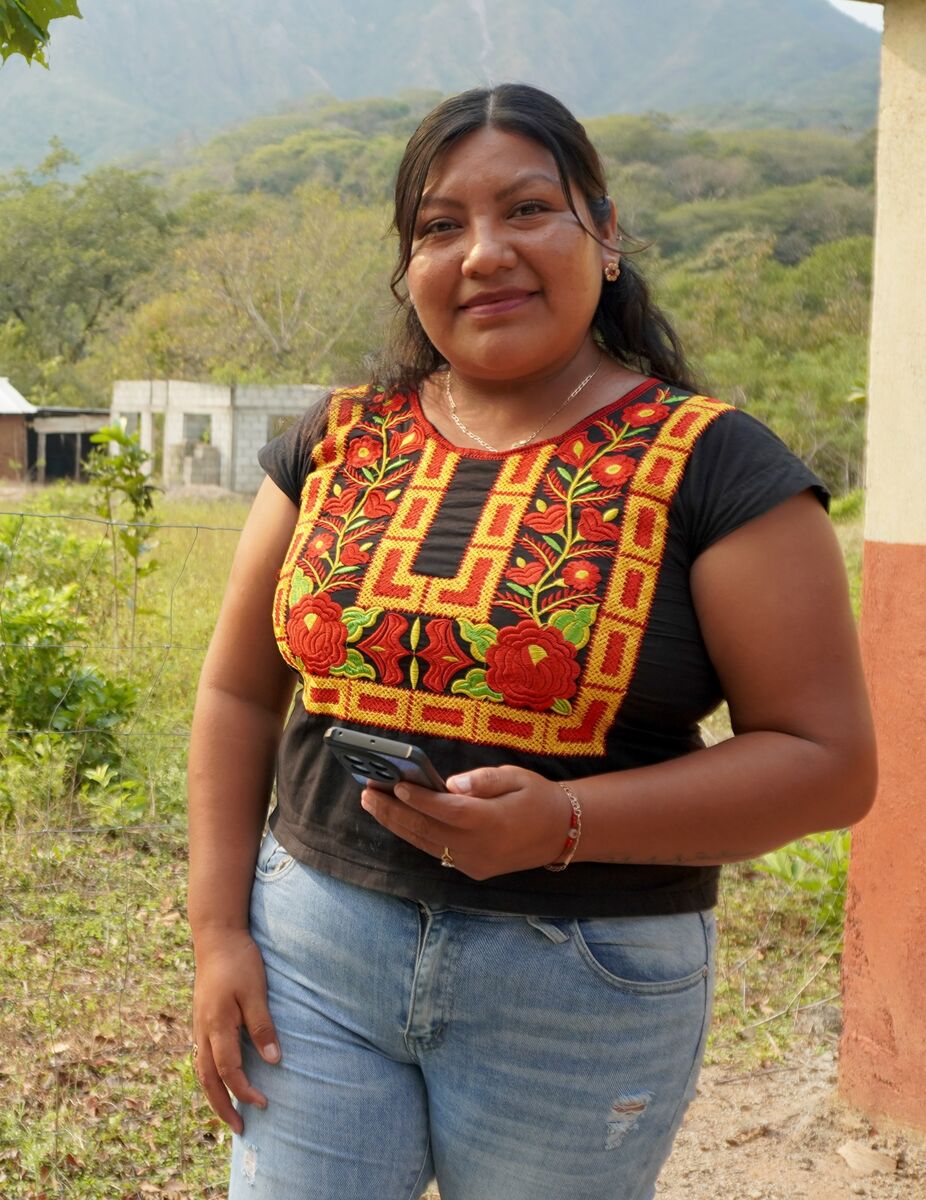
Cristina Pacheco Silva is a member of the 5 de Noviembre La Cristalina community, located in San Miguel Chimalapa, Oaxaca. As the wife of a communal landholder and an active participant in community assemblies, Cristina has dedicated much of her life to the voluntary conservation of the local ecosystem, which includes vast forests, unique wildlife and plant species, as well as rivers that are the lifeblood of the region. This work, carried out without government financial support, faces challenges such as illegal logging, poaching, and fires caused by outsiders.
Amid these difficulties, Cristina envisions a future where technology and sustainability go hand in hand. One of the most promising initiatives is a carbon credit program, which will allow the community to generate income to strengthen environmental protection and fund basic services. For Cristina, this income not only represents an opportunity to fight fires and improve infrastructure but also to launch productive projects that benefit families.
However, access to these resources faces a major obstacle: the lack of connectivity and modern financial services. Currently, payments are made in cash, checks, or vouchers, forcing community members to travel an hour and a half to the nearest town to cash them, losing time and money. “When my husband gets paid, he has to go to the neighboring town to cash the check or withdraw money. We lose almost two days,” Cristina explains.
San Miguel Chimalapa is one of Mexico’s largest community-managed forest territories, with the potential to generate significant income from carbon-credit sales. These revenues are intended to benefit more than 4,500 landowners, yet payouts would normally be handled through a manual, cash-based system without digital records or transparent tracking. Long distances, limited financial access and the absence of verifiable documentation create delays, inconsistencies and a risk of under-payment, especially for women and unbanked households. Buyers increasingly require proof of fair benefit-sharing, and communities need a trusted, auditable mechanism that strengthens confidence in climate finance and supports long-term forest stewardship.
The Better Than Cash Alliance is testing a transparent digital payout system that still respects community decision-making. Instead of carrying large amounts of cash to remote villages, climate revenues would move through a rules-based system that applies community-approved formulas and credits each person’s share to an individual account. People could keep funds digitally or cash out through nearby agents. The pilot aims to show that climate finance can reach Indigenous landowners more fairly and safely.
For Cristina digital payments would be a game-changer: reducing travel, saving time, and providing greater transparency in resource management. “It would be very important to use technology, as long as we have internet access,” she says.
Cristina dreams of a community where conservation and technology move forward together. “With the carbon credits, we hope to improve the community,” she says with hope. For her, the arrival of digital payments would not only make daily life easier but also open the door to sustainable development that preserves San Miguel Chimalapa’s most precious treasure: its ecosystem.